
By Luc-Yves Pagal Vinette, Chief Strategy Officer
Introduction
The convergence of Telcos and Techcos is a rapidly evolving landscape, driven by the increasing demand for edge-based services and the need for network operators to monetize their investments. While it’s clear that hyperscalers will play a significant role in providing edge services, Telcos possess a unique advantage in offering connectivity and infrastructure.
Many Telcos in North America and Asia-Pacific are strategically shifting their focus towards Telco Cloud and Network-as-a-Service (NaaS) to capitalize on this opportunity. However, integrating with hyperscalers requires a careful approach to avoid potential pitfalls.
A single hyperscaler integration can offer a faster time-to-market but may lead to vendor lock-in, pricing fluctuations, and API-driven limitations. This can hinder multi-cloud collaboration and limit flexibility.

A multi-cloud approach is more advantageous in the long run. By developing an API platform, Telcos can create end-to-end solutions that are flexible, scalable, and adaptable to the evolving needs of the market. This approach also fosters a more competitive environment and reduces reliance on a single vendor.

In this blog post, we will explore the key considerations for Telcos seeking to integrate with hyperscalers. We will discuss the benefits and challenges of both single-hyperscaler and multi-cloud approaches, and provide insights into the development of API platforms. Additionally, we will examine the role of AI and overlay connectivity in shaping the future of Telco-Techco integration.
Our CEO Alex Lacis confidently states, “The future of connectivity is anchored in the seamless integration of Telco and Techco services. By uniting our unparalleled expertise in infrastructure with their groundbreaking innovations in technology, we are poised to usher in a new era of opportunities for our Technology and enterprise customers.”
The Need for Accelerated Monetization
Telcos have invested heavily in wireless infrastructure, but monetizing these investments can be challenging due to factors such as increasing competition, declining ARPU (Average Revenue Per User), and the rise of over-the-top (OTT) services. To address these challenges, Telcos are exploring new opportunities to create value and generate revenue from their wireless assets.
One powerful strategy is to integrate Telco service assets and applications with those provided by hyperscalers. By harnessing hyperscaler strengths in areas such as cloud computing, advanced monitoring, AI components, data analytics, and connectivity solutions (Overlay Networking), Telcos can launch groundbreaking products and services that meet the dynamic demands of their customers. This approach will drive higher ARPU, enhance customer satisfaction, and unlock new revenue opportunities.
Several telcos, such as Telefonica, Singtel, Verizon, Orange, and Lumen, are boldly charging ahead with their ambitions in Telco Cloud and API platforms, as they seek to dominate the integration of telco and hyperscaler services. These API platforms aren’t just tools; they’re revolutionizing the game by unleashing the potential for end-to-end solutions, supercharging the monetization of existing services, and igniting the growth of a thriving API economy.
Key benefits of combining Telco and hyperscaler services:
- Increased ARPU: By offering new and innovative products and services, Telcos can increase ARPU and generate additional revenue.
- Improved customer experience: Combining Telco and hyperscaler services can create a more seamless and personalized customer experience.
- New revenue streams: Telcos can develop new revenue streams by offering value-added services based on hyperscaler capabilities.
- Enhanced flexibility: API platforms can provide Telcos with the flexibility to rapidly develop and deploy new services.
To maximize the benefits of Telco-hyperscaler integration, Telcos should:
- Develop a flexible API commercialization platform supported by cloud-native BSS and OSS layers.
- Explore innovative pricing models, such as time-of-day pricing, QoS/CoS on-demand pricing, daily API usage pricing, location-based pricing, and pricing for enriching applications like drones and cameras.
- Partner with hyperscalers that have complementary strengths and a shared vision.
- Focus on creating value-added services that address the specific needs of their customers.
Additionally, to efficiently integrate with hyperscalers, Telcos must identify and address key points of convergence. These areas include:
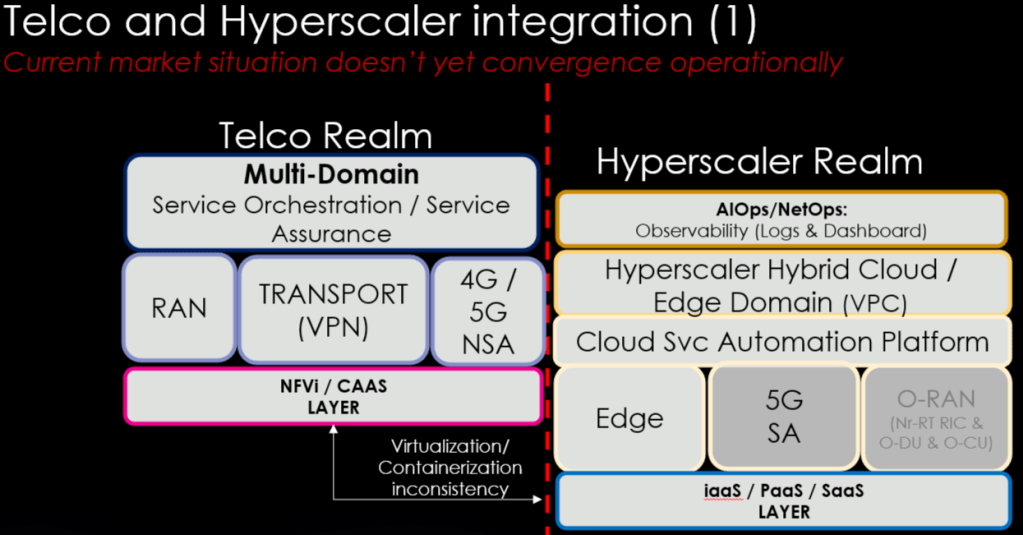
- Service Assurance: Implementing a unified service assurance framework that leverages technologies like Kafka to stream events and KPIs to both Telcos and Techcos.
- Service Orchestration: Providing end-to-end and edge orchestration capabilities to ensure seamless integration of infrastructure, connectivity, and applications.
- API Integration: Developing a robust API platform to facilitate the integration of Telco and hyperscaler services and enable the development of new products and services.
- Virtualization and Containerization: Ensuring consistency in virtualization and containerization technologies for network functions, regardless of whether they are deployed in Telco clouds or hyperscaler edge locations. This can help reduce operational costs, improve time-to-market, and simplify management.
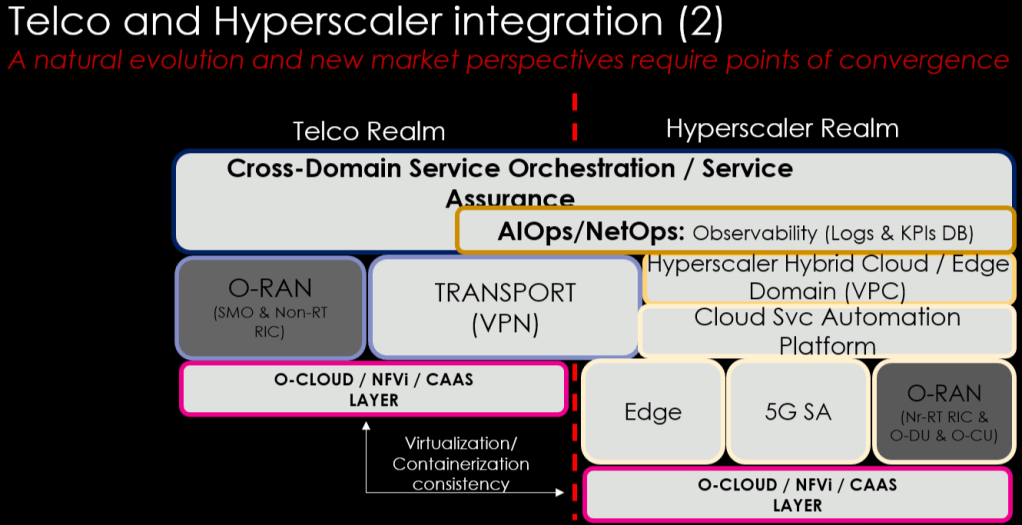
By focusing on these areas of convergence, Telcos can:
- Improve operational efficiency and reduce costs
- Enhance customer experiences
- Accelerate the development of new products and services
- Strengthen partnerships with hyperscalers
Specific benefits of focusing on these areas include:
- Reduced operational costs: Consistent virtualization and containerization can lead to significant cost savings by reducing training costs, licensing fees, and the time required to resolve outages.
- Improved time-to-market: A well-integrated service assurance and orchestration framework can accelerate the deployment of new services and features.
- Enhanced customer experiences: By providing a seamless and unified experience across different services and platforms, Telcos can improve customer satisfaction and loyalty.
- Strengthened partnerships: A focus on convergence can help Telcos build stronger partnerships with hyperscalers and other technology providers.
In addition to these benefits, focusing on these areas of convergence can also help Telcos:
- Avoid vendor lock-in: By adopting a multi-cloud approach and using open standards, Telcos can reduce their reliance on a single vendor.
- Improve network performance: A well-integrated and optimized network can deliver better performance and reliability for customers.
- Enable new business models: By combining Telco and hyperscaler capabilities, Telcos can explore new business models, such as managed services and AI-powered solutions.
Hyperscalers and Telcos/Techcos should also focus on the following areas of convergence:
- Data management and analytics: Developing joint solutions for data management, analytics, and insights.
- Security: Collaborating on security best practices and developing joint security solutions.
- Regulatory compliance: Working together to navigate complex regulatory environments.
- Joint product development: Creating new products and services that leverage the strengths of both Telcos and hyperscalers.
Wireline/Wireless Convergence
The merger of wireline and wireless networks is not just an opportunity; it’s a wake-up call for Telcos to shake off the shackles of commoditization and seize true economies of scale. By fusing their wireline and wireless operations, Telcos can forge a powerful, streamlined network that not only enhances customer experiences but also slashes operational costs. The time to act is now—either innovate or become obsolete!
Key benefits of wireline/wireless convergence:
- Avoid commoditization: By offering a comprehensive suite of wireline and wireless services, Telcos can differentiate themselves from competitors and avoid commoditization.
- Economies of scale: A unified network can lead to economies of scale in areas such as operations, maintenance, and infrastructure.
- Improved customer experience: A converged network can provide customers with a more seamless and consistent experience, regardless of whether they are using wireline or wireless services.

Challenges of wireline/wireless convergence:
- Different technologies: Wireline and wireless networks are based on different technologies, which can make integration complex.
- Operating models: Telcos often have separate operating models for their wireline and wireless networks, which can hinder integration efforts.
- Customer experiences: Customers may have different expectations for wireline and wireless services, which can make it challenging to provide a unified experience.
Addressing these challenges requires a comprehensive approach. A unified OSS/BSS platform can provide a common framework for managing both wireline and wireless services. This platform can streamline operations, improve efficiency, and enhance customer experiences.
Additionally, a Multi-Domain Service Assurance framework can help ensure the quality and reliability of services across both wireline and wireless networks. This framework can provide real-time monitoring, troubleshooting, and performance management capabilities.
A key advantage of wireline/wireless convergence is the ability to leverage the 5G core network as a unified platform for authentication, data management, and service provisioning. As suggested by the Broadband Forum’s AGF function, the 5G core can provide a common foundation for both wireline and wireless services, simplifying operations and improving efficiency.
By combining wireline/wireless convergence with a unified OSS/BSS platform, Multi-Domain Service Assurance, and the 5G core, Telcos can create a more efficient, flexible, and customer-centric network. This will enable them to compete effectively in a rapidly evolving market and drive long-term growth.
The Role of AI
Artificial intelligence (AI) is playing an increasingly important role in the telecommunications industry. Telcos can leverage AI to improve network performance, enhance customer experiences, and develop new revenue streams. However, integrating AI into Telco operations can be complex, especially when considering the different types of AI models available.
Direct AI involves Telcos developing and deploying their own AI models. This approach gives Telcos full control over their AI capabilities but can be resource-intensive and time-consuming.
Indirect AI involves partnering with AI providers to access their models and expertise. This approach can be more cost-effective and time-efficient, but it may limit Telcos’ control over their AI capabilities.
Externally Driven AI refers to AI models developed by third-party vendors. This approach can provide Telcos with access to cutting-edge AI technology but may require significant customization and integration efforts.

Integrating these different types of AI models into Telco operations can be challenging due to factors such as data silos, legacy systems, and the complexity of AI algorithms. To address these challenges, Telcos should consider adopting an AI-native approach.
An AI-native approach involves designing and building networks and applications with AI in mind from the outset. This approach can help ensure that AI is seamlessly integrated into Telco/Techco operations and can deliver maximum value.
Bio-Inspired Computing represents a significant advancement in the quest for a more intuitive and brain-like architecture in artificial intelligence. Bio-Inspired optimization algorithms are widely acknowledged in machine learning for their ability to emulate the mechanisms of swarm intelligence, which allows for a more natural and efficient processing of information. By harnessing Bio-Inspired AI, telecommunications companies are better equipped to tackle complex challenges that are often nonlinear and subject to numerous constraints, including time limitations and high dimensionality across various operational and abstraction layers, ultimately striving to achieve optimal solutions.
AI holds immense promise to transform the telecommunications industry, and while integrating various AI models may appear challenging, it presents an exciting opportunity. By adopting an AI-native mindset and leveraging remarkable advancements such as AI Native, Telcos can confidently overcome these hurdles and harness the incredible potential of AI to enhance their operations and take customer experiences to unprecedented levels!
Overlay Connectivity and AI-Native Capabilities
Overlay connectivity plays a crucial role in enabling the integration of Telcos with hyperscalers, MVNOs, and MVNEs. By providing a flexible and scalable way to connect these different entities, overlay connectivity can facilitate the development of new products and services, improve customer experiences, and drive revenue growth.
However, the complexity of overlay connectivity can be significant, especially in today’s dynamic and rapidly evolving market. To address these challenges, Telcos/Techcos should leverage AI-native capabilities.

AI-native capabilities can provide valuable insights into network performance, service usage, and application behavior. By analyzing this data, Telcos can optimize their overlay connectivity solutions, adapt to changing market conditions, and ensure that their services meet the evolving needs of their customers.
Key benefits of using AI-native capabilities in overlay connectivity:
- Improved network performance: AI can be used to optimize network routing, traffic management, and resource allocation, leading to improved performance and reliability.
- Enhanced customer experience: AI can provide personalized recommendations, proactive support, and tailored service offerings, enhancing the customer experience.
- Adaptive charging and billing: AI can enable adaptive charging and billing models that are based on real-time usage patterns and customer preferences.
- Intelligent orchestration: AI can automate the orchestration of network resources, services, and applications, reducing manual effort and improving efficiency.
By leveraging AI-native capabilities, Telcos can create more intelligent, flexible, and responsive overlay connectivity solutions. This will enable them to better meet the needs of their customers, drive revenue growth, and stay competitive in a rapidly changing market.
Our CTO Ishkhan Martirosyan boldly contends: “AI Native and Bio-inspired platforms are poised to completely upend overlays, forcing networks to not merely adapt, but to intelligently respond to the constantly evolving landscape in real-time. This means networks can react instantaneously to traffic fluctuations, security threats, or system crashes—eliminating the need for outdated rules or human oversight. Get ready, because this will radically transform what we deem possible in performance, security, service concepts, and customer experience.”
Conclusion
The evolution from Telcos and Techcos presents a significant opportunity for the telecommunications industry. By integrating their capabilities, Telcos can create innovative new products and services, improve customer experiences, and drive revenue growth.
Overlay connectivity is a key component of this transformation. By providing a flexible and scalable way to connect Telcos with hyperscalers, MVNOs, and MVNEs, overlay connectivity can enable the development of a wide range of enriched solutions.
However, realizing the full potential of overlay connectivity requires a new paradigm. Telcos must adopt a multi-cloud approach, leverage AI-native capabilities, and focus on developing API-driven platforms.
Contacts :
CEO Alex Lacis : alex@ambear.eu
CSO Luc-Yves Pagal Vinette : luc@ambear.eu
CTO Ishkhan Martirosyan : ishkhan@ambear.eu
#overlaynetworks #APIeconomy #networktransformation #APImonetization #technology #connectivitycommoditization #customerchurn #digitaltransformation #analytics #artificialintelligence
 AMBEAR GROUP